
If you've ever said "at least I didn't lose" and then spent the rest of the day watching the trade you just closed go exactly where you thought it would — this one's for you. It's one of the most common, most expensive habits in trading, and almost nobody talks about it honestly.
What actually happens
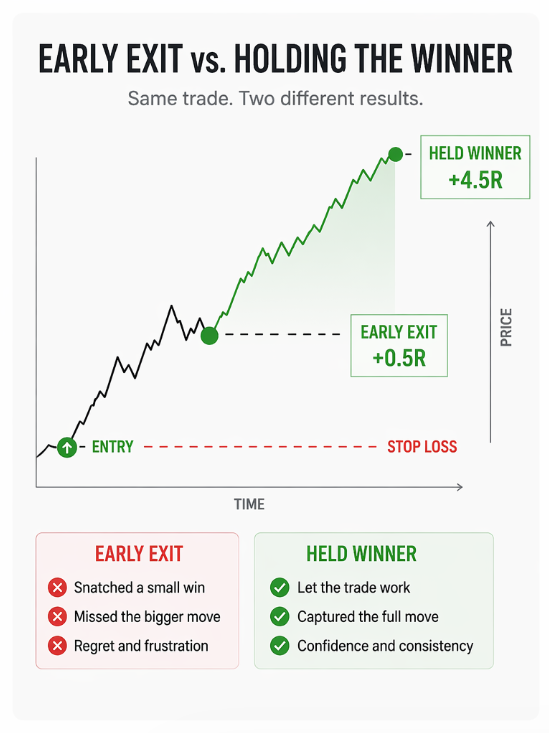
The 0.3R snatch. You close a tiny green trade just to "lock something in." It feels responsible. It isn't — it's anxiety wearing a suit.
The runner you missed. Same setup, same chart, four hours later. Five R higher. You're still telling yourself you "managed risk."
The skewed math. Tiny wins, full-size losses. Even with a 60% win rate the account bleeds quietly until you can't ignore it.
Why you do it
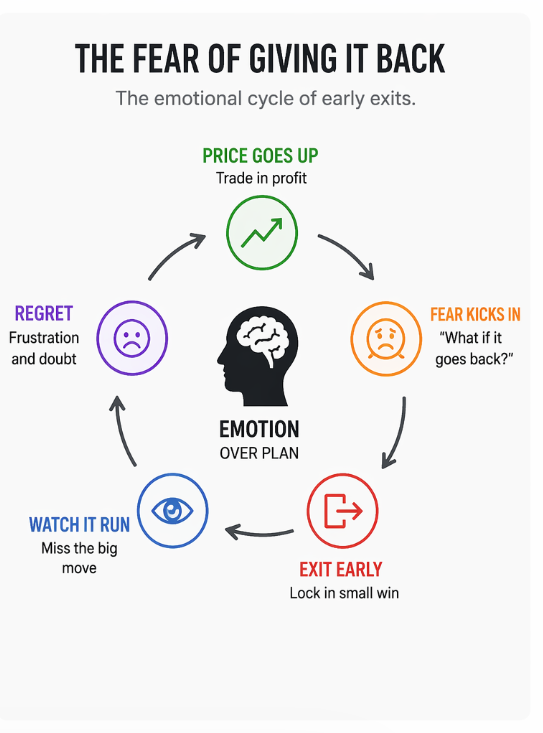
Fear of giving it back. Green on the screen feels fragile. Your brain treats unrealised profit like it's already yours — and the thought of "losing" it hurts more than the upside of letting it run.
Past pain. One winner that turned red rewires you for months. The next ten trades you close early to avoid the feeling — not because the setup changed.
Needing to be right. A closed +0.3R is officially a "win." An open +2R isn't a win yet — it's just a number that could still let you down.
No defined target. Without a plan exit, every tick up feels like the top. Every pullback feels like the reversal. You're flying blind, so you grab and go.
The real damage
Asymmetry breaks. Most strategies need 2R+ winners to survive 1R losers. Cap your wins at 0.5R and the math collapses — quietly, then all at once.
"Cutting winners early isn't discipline. It's discomfort with uncertainty dressed up as discipline."
You stop trusting your setups. If you never let one run to target, you'll never know whether the system actually works. So you keep tweaking instead of trusting.
Confidence becomes fragile. Confidence built on tiny wins is brittle. The first real drawdown rips through it in a week.
Why it keeps happening
In the moment, snatching a small win always feels "responsible." Looking back across a month, it's the same trade twenty times.
Without tracking, every early exit feels like a smart, individual decision. With tracking, the pattern stops looking like wisdom and starts looking like a tic.
What actually helps
Decide the exit before the entry. Stop, target, partial level — written down before you click buy. If it isn't decided beforehand, you're improvising under stress.
Use partials, not panic. Take a third at 1R if you have to. Leave the rest. You get the dopamine hit and you keep the runner.
Trade smaller. If +0.5R feels too good to give up, your size is too big. Shrink it until letting it run feels boring.
Track why you exited. Plan? Fear? Boredom? FOMO? The reason matters more than the price. Three weeks of honest answers will show you exactly what's costing you.
"There's no single fix for this — it's a habit, not a bug. A few things help: a written trade plan, screenshots of every exit, a notebook by the desk. Out of the tools I've tested, Recall Vault was the one that actually surfaced the pattern, because it logs the emotion at exit, not just the price. Not the only option — just the one that stuck for me."
The takeaway
You don't have a strategy problem. You have an exit problem.
Fix the exits and the equity curve fixes itself.